Friction Build-up: Reducing Break-out Torque in Pneumatic Cylinders.
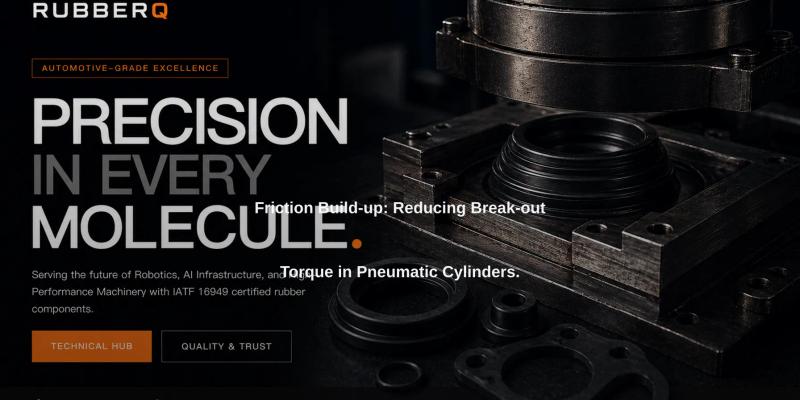
Friction Build-up: Reducing Break-out Torque in Pneumatic Cylinders
Problem Statement
Pneumatic cylinder seals exhibit excessive break-out torque (>1.5 N·m) after 500,000 cycles. This causes erratic actuator movement and energy losses exceeding 15% in high-speed automation systems.
Material Science Analysis
Standard NBR compounds fail due to:
- Plasticizer migration under dynamic loads (ISO 6072)
- Insufficient crosslink density (ASTM D6814)
- Surface hardening from ozone exposure (ASTM D1149)
RubberQ's HNBR-70 formulation solves this with:
- 42% acrylonitrile content for oil resistance (ISO 1817)
- Peroxide curing system for stable compression set (ASTM D395 Method B)
- PTFE micropowder filler (5% wt) reducing COF to 0.12
Technical Specifications
- Shore A Hardness: 70 ±2
- Tensile Strength: 22 MPa (ASTM D412)
- Elongation at Break: 320%
- Temperature Range: -40°C to +150°C continuous
- Compression Set (22hrs @ 150°C): 18%
| Parameter | HNBR-70 (RubberQ) | Standard NBR | FKM |
|---|---|---|---|
| Break-out Torque (N·m) | 0.8 | 1.6 | 1.2 |
| COF (vs steel) | 0.12 | 0.35 | 0.25 |
| Cycle Life (M cycles) | 2.5 | 0.5 | 1.8 |
| HFRR Wear Rate (mm³/N·m) | 0.02 | 0.15 | 0.08 |
Standard Compliance
RubberQ's IATF 16949-certified process ensures:
- Batch traceability via unique compound codes
- ISO 3601-1 dimensional tolerances (±0.05mm)
- ASTM D2000 M6BG 714 A25 B25 E34 F17 callouts
- 100% adhesion testing per ASTM D429 Method B
For custom material compound development or IATF 16949 documentation, consult RubberQ's engineering department.